
Things I'm reading - Always be Primarying
Hope is a dangerous thing for a primary voter to have
(This was almost out the door when the major AI news broke. The Nvidia Board took perhaps the most nakedly corrupt, unethical, and stupid decision ever committed in the history of capitalism, and Tidal went the opposite, obvious but brave, direction choosing to banish AI content. More on those choices next time.)
There’s no clearer argument for why there always needs to be a Primary for elected officials than the 2020-2026 period. Going into the 2024 Election anyone who questioned Biden, or pointed out that Biden himself ran as a single-term, transitional candidate in 2020, were mercilessly attacked. They were called Communists (I feel seen), told they were supporting terrorist organizations (everyone but your government and military are terrorists you see), accused of helping Trump win, and on and on. In 2026, long-shot Democratic Primary challengers won because they actually acknowledged the rapidly expanding hellscape we exist in, and voters clearly wanted aggressive and responsive representation to counter those threats.
Over the same set of years and election cycles, the Republican party had every opportunity to avoid the incredibly embarrassing 2026 defeat if they had simply managed to oppose Trump in the 2020 or 2024 Primaries. Because in our uniquely flawed US two-party system, neither party actually represents voters, they represent donors and special interests. Because voters don’t have the time or the the funds to stay on elected officials 24/7, 365. Where as the wealthy can pay someone to do that dirty and frustrating work for them. When incumbent candidates have primary challenges, they’re forced to justify their past policy or statements. They must take ownership and accountability for their behaviors, statements, policy accomplishments, and political setbacks.
In a two party system, there’s not space for policy debates or an educated electorate in the General. Every election boils down to “This War Will Destabilize The Entire Mideast Region And Set Off A Global Shockwave Of Anti-Americanism vs. No It Won’t” won by a coin flip. A two-way election is a vote for damage mitigation, the lesser of two evils, a hedge against the worst possible outcome. It’s not an exciting, empowering, nor inspiring event for voters.

This War Will Destabilize The Entire Mideast Region And Set Off A Global Shockwave Of Anti-Americanism vs. No It Won’t - The Onion
George W. Bush may think that a war against Iraq is the solution to our problems, but the reality is, it will only serve to create far more.
All the real progress, change, and exploration of the policy landscape happens in the Primary. The opportunity for an intentional course correction, not a wild pinballing back and forth, can only come when there’s a diversity of ideas and a larger field than two sides defined by their opposition to one another. It’s a process, and it’s important that it plays out no matter if the challenger or incumbent wins. But that vital war of ideas can never happen if the incumbent is given deference and no one wants to challenge them out of “respect” or more likely, fear.
The debates, in formal settings, on campaign websites and social media, and at doors are important. The policy back and forth is important. Having to enunciate your priorities, explain your mis-steps, and make on the record promises is the basis for future progress. Even a candidate that ends up not winning puts pressure on the others, forcing them to go a little further, say something a little more revolutionary, support or oppose a policy they’ve been trying to avoid getting pinned down on. Let’s not fool ourselves. In every election cycle promises are being made. Policies are being discussed and committed to. The question is, who is in those rooms?
Incumbents, running unchallenged in Primaries are still raising money, at in person fundraisers, dinners, on the selfie line. You think the people in those spaces don’t have policy objectives? You think they aren’t pushing their personal pet policies, arguing for lowering taxes, enshrining their generational advantages into law, looking to further privilege their passive income and wealth accumulation? You think there aren’t well paid and well connected lobbyists handing those candidates fully written Bills, ready to be submitted? You think those lobbyists aren’t also at the legislative chamber leaders’ fundraisers and offices, pushing them to move those Bills to the floor for votes?
So that’s the “status quo” situation, the “business as usual,” the thing that’s being constantly reinforced and entrenched if there’s no challenge in the Primary. Maybe you’re eighty or even ninety percent happy with what you’ve seen or heard from the incumbent candidate. Shouldn’t you want someone to push them to be a candidate you could support on 95% of issues? Or maybe you find another candidate via the Primary that leap-frogs the incumbent and really gives you hope for the policies that you care about. Someone that might push policies that could literally change, or even save, your life and maybe even get them passed and enacted.
We see this almost every cycle in more local, non-partisan elections. Very few Mayoral races have just two candidates, the incumbent and one polar opposite candidate. We think nothing of these races having crowded fields, representing a wide range of policy positions, often bordering on caricature. The Self-made Entrepreneur Candidate. The Environmental Candidate. The Gee Shucks I’m Just Running Because of My Kids Candidate. The I’m Totally Not 3 Corporations in a Trenchcoat Candidate. The Rich Kid Burning Mommy and Daddy’s Money Candidate.
Why would we want more diverse ideas and deeper policy discussions and debates when electing our local Mayor than when we’re electing a US Senator or President? Why do we settle for the idea that the incumbent President should face no pressure from their own side of the aisle, but the part time Mayor should have to fight an expensive and bloody street battle to regain the right to cut ribbons and pet puppies at the animal shelter?
Worst case, a group of voters who would have backed a Primary challenger get the attention of the incumbent and are offered a meeting. They talk through policies and positions that are important to them, and discover the incumbent is actually interested in aggressively (and importantly, PUBLICALLY) adopting those positions. The candidate expresses the desire to be held accountable (again, PUBLICALLY) for their ability to adopt and vocally and legislatively advocate for those things. Not to play down the danger of co-option this represents, but y’all are smart, you know when someone’s bullshitting you.
The much more likely case, at least in my experience, is that the incumbent will simply blow you off. Maybe they give you a meeting, hoping you’ll feel heard, so you’ll just go away. They don’t see you as a serious threat, because why would they? Most of their elections they’ve run unopposed in the Primary, and cruised to an easy win in the General. They feel absolutely no pressure to represent you, your group, your community, because they were elected on “merit,” you see. They have great ideas, they’re personable, they can fundraise. Or maybe they’re just pliable and the local machine knows they will play ball. But none of those skills make voters’ lives better.
Nothing shakes up an incumbent like a challenger in the Primary, especially if it’s been a few cycles and they’ve grown comfortable. Nothing stagnates policy and support for important cultural and societal movements like having an incumbent who thinks they’re entitled to die in office in that seat. So groups should be actively working to recruit potential challengers for every Primary cycle. You never know when your incumbent elected will do something stupid a week before the filing deadline and you’ll rue not being ready.
Subscribe so you can get my posts directly to your inbox, avoiding dependence on social media, which benefits both of us.
Acting
Protect workers, because we know the “free market” and capitalism never will
New Jersey Workers Deserve More: Heat Standard Now! | American Civil Liberties Union
Please take action!
Donating
Support showings and promotion of the “Seeds for Liberation” Documentary
Listening

hope is a dangerous thing for a woman like me to have - but I have it by Lana Del Rey on TIDAL
Listen to hope is a dangerous thing for a woman like me to have - but I have it on TIDAL in exceptional sound quality, or on your choice of service
Reading
Republicans bet everything on anti-trans messaging. It didn’t pay off. by Brooke Migdon, Orion Rummler
Contributions to Republican-aligned groups and GOP candidates by Elon Musk, the world’s richest person, totaled nearly half a billion dollars, The New York Times reported, millions of which were spent on digital and television ads hammering Democrats over their past support for trans rights. Musk’s America PAC itself churned out dozens of ads painting Democratic candidates as supporters of a “radical trans agenda” in the election’s final stretch. James Talarico, the Texas Democrat who just won his Senate seat, was a frequent target of those ads.
“That in itself is pretty telling — not that these anti-trans ads didn’t seem to work, but having all the money to spend on these anti-trans ads didn’t seem to help,” said Don Haider-Markel, a political science professor at the University of Kansas.
Republican candidates, he said, did not campaign on a clear platform or offer voters adequate solutions to their most pressing concerns. In polls released ahead of Election Day, Americans consistently ranked trans issues low on their list of priorities.
“All these efforts to paint Democrats as ‘pro-trans’ don’t seem to have had their intended effect, but it’s also an election cycle where affordability issues, the war with Iran and corruption, it turns out, were so front of mind with voters,” Haider-Markel said. “It’s not really clear to me that any other message could get through to voters other than those issues.”
…
Republicans leaned heavily into anti-trans rhetoric on the campaign trail, hoping to cash in on broadening support for restrictions on trans rights while steering clear of voter frustration over the rising cost of living. In a recent 19th/YouGov poll, nearly half of adults said they were more likely to vote for a candidate who supports banning trans athletes from girls’ and women’s sports over one who does not.
But survey data also suggests that most Americans believe trans people should have equal rights, protections and general respect.
More than a third of adults in the 19th/YouGov poll said politicians shouldn’t focus on trans issues and that both Democrats and Republicans talk “too much” about trans people. In a 2024 survey by Data for Progress, a progressive think tank, more than half of voters said political campaign ads targeting trans people “have gotten mean-spirited and out of hand.”

Republicans bet everything on anti-trans messaging. It didn’t pay off.
Transphobic attacks got louder, harsher and more personal. Democrats used it as an opportunity to talk about their values — and won.
The Gatekeepers: Dispatch from an Israeli Jail by Jasper Nathaniel
This February, the Israeli military installed a gate across a busy road in the South Hebron Hills. It was a simple contraption, maybe twenty feet of yellow steel that swung open like the door of a cattle pen—one of hundreds erected across the West Bank. But this one blocked the only drivable road into the tiny Palestinian village of Umm al-Khair as well as more than twenty other shepherding communities, home to thousands of people.
For the past nine months, soldiers have routinely locked the gate for days at a time, preventing residents from reaching work or school, blocking deliveries of food and supplies, and limiting access to hospitals and emergency medical care. Those who manage to drive through during a brief opening may return to find it locked, leaving them stranded on the wrong side, with no way home. Whenever soldiers close the gate, life in Umm al-Khair grinds to a halt. A closed gate also serves as a warning: a settler attack may be coming.
…
At ten the next morning, we heard the familiar rumble of military jeeps and rushed to the gate, arriving just in time to see soldiers unlocking it. They gave no explanation of their actions—the IDF rarely does. As word spread, cheers erupted. Cars rushed in and out as residents hurried to work, visited nearby friends and family, and shopped for groceries in Yatta, the nearest city. It didn’t last. At 10:45 A.M., a local settler named Shimon Atiya arrived and locked the gate back up.
Shimon is the founder of an illegal farming outpost near Umm al-Khair. He’s an angry man, perpetually talking into an earpiece, known for overturning dumpsters and kneeing men in the groin. Though he carries a military-grade assault rifle, he is not in the IDF and has no formal authority in the sprawling military occupation that governs Palestinian life. …
…
… a soldier showed us a map of a newly declared Closed Military Zone (CMZ)—an arbitrary designation used to expel activists and journalists from Palestinian villages—and ordered us to leave.
Ostensibly, CMZs restrict all nonresidents from a designated area. But while we were speaking, a settler drove straight through the restricted zone. When I asked the soldier in charge whether he intended to expel the settler, he shook his head. The order, it seemed, applied only to us. Even so, the map left a small part of the village unrestricted. We pointed this out, and the soldiers reluctantly allowed us to stay. But if we entered the restricted area, they warned us, we would be placed under arrest.
You really need to read this whole thing. It’s long, but the details are important and it paints an extremely clear picture of this policy of apartheid, oppression, occupation, and ethnic cleansing that the US Government, under both parties, has supported, funded, and armed.
https://www.theparisreview.org/blog/2026/11/16/gatekeepers-israeli-detention-palestine-jasper-nathaniel/Matt Duss: End The Iran War, End The Blockade, Stop The Israel Merger by Spencer Ackerman
SA: When we speak about those countervailing forces, after the election, how do you see the order of battle in terms of the forces aligned against progressive and socialist foreign policy? Are they regrouping? Do you see them as ultimately showing a glass jaw? Something in the middle?
MD: I think what we've seen a lot unfortunately is, and I don't know that this will be the first thing, but we've seen a lot, we saw this obviously, Ilhan Omar is an example of this, of using accusations of antisemitism to split Democrats and to kind of keep progressives on their back foot.
SA: Rashida Tlaib…
MD: Rashida Tlaib as well. I mean, the fact that the only member of Congress to be censured for comments in the wake of October 7th was the one Palestinian, that's disgusting, just on its face. That is absolutely disgusting.
SA: And, I want to add, so is the attempted denaturalization and deportation of Ilhan Omar.
MD: Absolutely. Absolutely. So listen, we saw some of the worst anti-Muslim bigotry and Islamophobia directed at Abdul El-Sayed in Michigan. And again, I'm someone who's researched Islamophobia for almost 20 years. This was horrible shit. It's just like the grossest and dumbest, like creeping Sharia, taqiyya [the accusation that Muslims are religiously sanctioned to lie to nonbelievers], all the usual stuff that I had hoped at one point would be fading out, but it's just come roaring back.
SA: That said, it just got defeated.
MD: It got defeated. That's absolutely right. I think that's really important to note. But we also saw attempts to use antisemitism accusations against him. And obviously don't downplay the unfortunately growing prevalence of antisemitism. But clearly it was being used in an instrumental way against Abdul El-Sayed. We've seen it used in the same way against some of the other members who I just mentioned, and against the broader kind of progressive foreign policy coalition. Unfortunately, I think we're going to see that. I think it's going to have much less truck than it's had in the past. But I think it's really on Democrats, particularly progressive Democrats, not to fall for it.
SA: Do you see this as being an area, meaning ending support, ending military largesse to Israel, and stopping the merger of the defense-technological bases, where progressive and anti-Zionist Democrats could have active partnerships on the Republican side as well?
MD: I think so. Yeah. I mean, that's one of the more interesting developments I think in the foreign policy left-right, transpartisan coalition. Sometimes a rough coalition, but at least a shared interest in doing much less stupid stuff around the world. Critics from the establishment will call this isolationism, but that's a bunch of nonsense. I think the real question is, does it move beyond the fringes into the real mainstream?
And the key question here is, where does Donald Trump land on this? Because he still has enormous control over the caucus. I think the question you asked is a good one, but I think it's part of a bigger question of, okay, at what point do we start to see Republicans in the House and Senate start to show any real independence from Trump in any real numbers? And a normal president would enter his lame duck period a little bit chastened, but this is not a normal president, and he will not be a normal ex-president.
I mean, I think this is someone who will still probably retain the ability to do real damage to members of Congress even after he leaves office. As long as he's got his phone, and he's able to put out social posts condemning Congressman or Congresswoman So-and-So, he's going to remain a force. That power could ebb, but that's why I'm saying I'm not making a prediction.
Matt Duss: End The Iran War, End The Blockade, Stop The Israel Merger
The foreign-policy adviser to Bernie Sanders and Alexandria Ocasio-Cortez tells Dems not to fear voting down the National Defense Authorization Act
Two charts to explain the GOP’s historic midterm loss by Stephen Semler
Policies (and politicians) with negative net support are said to be underwater. The Iran War is the first US war to be fought entirely underwater.
It’s the first US war to begin with negative net support. At no point have more Americans supported than opposed it. So when Pentagon Secretary Pete Hegseth said in a Senate hearing on the Iran War that “I believe we do have the support of the American people,” he wasn’t reporting facts. Perhaps he was manifesting.2
The Iran War is similar to all other US wars in one important respect: it’s gotten less popular over time. From mid-March to mid-September, net support for the war has dropped among all voters, including falling by 5 percentage points among Democrats, 12 points among Independents, and 24 points among Republicans. In terms of Tuesday’s election results, that last drop was likely the most politically consequential.
…
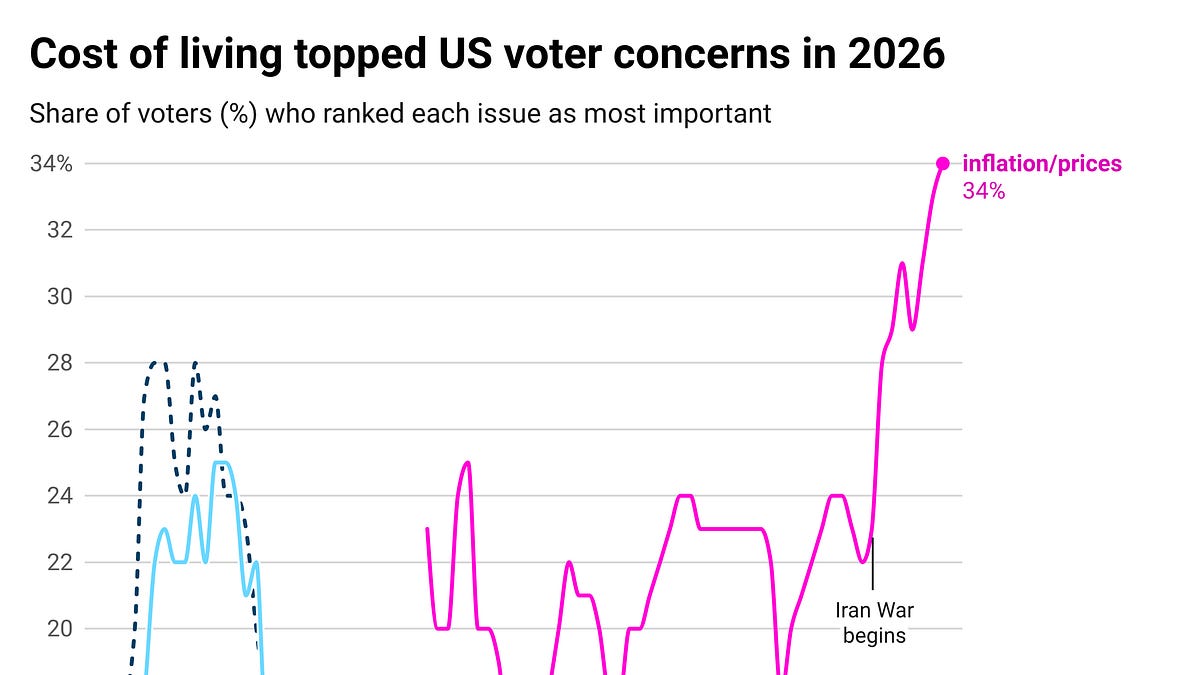
Cost of living isn’t captured by the macroeconomic indicators typically used to gauge the health of the economy, like GDP, unemployment, and stock market performance. “The economy” may emerge as the prevailing reason Republicans lost the 2026 midterms, but most people evaluate economic conditions at the human, not national, level.
Voters make this distinction when pollsters let them. A weekly Economist/YouGov poll asks US voters what issue is most important. Midway through 2022, voters typically ranked “jobs and the economy” as their top concern. That changed in the July 19, 2022 survey, when “inflation/prices” was added as an option: it immediately became the most popular response, at 24%, while the “jobs and the economy” option immediately fell from 19% to 12%.
This speaks to the crucial distinction people make between the state of a nation’s economy and their own economic conditions. Cost of living is about the latter.
This graph shows the five issues ranked by voters as most important going into the 2026 elections. I averaged the weekly survey data into months for readability, but the graph still isn’t all that readable. Looks like a Jackson Pollock painting.
But the takeaway is clear: there are important issues, then there’s cost of living, which is the issue. The last two administrations neglected to address it, and voters punished them for it in the last two elections. That’s the thing about a two-party system — it often feels like you’ve only got one.
Two charts to explain the GOP’s historic midterm loss
Polygraph | Newsletter n°353 | 6 Nov 2026
ICE may have cost Republicans more votes than inflation did in 2026 by G. Elliott Morris
So what else mattered for Democrats’ huge 2026 victory?
First, immigration and deportations. In our polls, Trump lost more ground on immigration than on prices from May 2025 to February 2026, and his immigration ratings tracked his overall approval more closely than his rating on prices did. And point for point, his immigration rating mattered at least as much for the 2026 House vote intention as prices did.
After that, there’s corruption. In our polling, Trump’s own voters who were critical of him on corruption defected from the GOP about as often as the ones who were angry about prices.
Throughout 2025 and 2026, voters routinely told pollsters that prices and the economy were the Most Important Problems (“MIP,” in pollster parlance) facing the country today. But while the MIP question helps identify which issues are front of mind for most voters, that is not the same as discerning the issues that actually moved their voting decisions. Everybody cares about prices, but which issues actually flipped votes, and by how much — those are the questions to ask in an analysis of why Democrats won.
In this piece, I use our original independent polling to (a) measure how much each of 14 issues drove down both Donald Trump’s approval rating and vote share for Republicans in Congress, (b) show that immigration and corruption cost Trump significant support among his own 2024 voters, and (c) make the case for a multi-causal analysis of Democrats’ victory in 2026.
At the very least, prices are not the only thing that mattered this cycle. And at most, there’s a decent empirical case that other issues may have even mattered more.
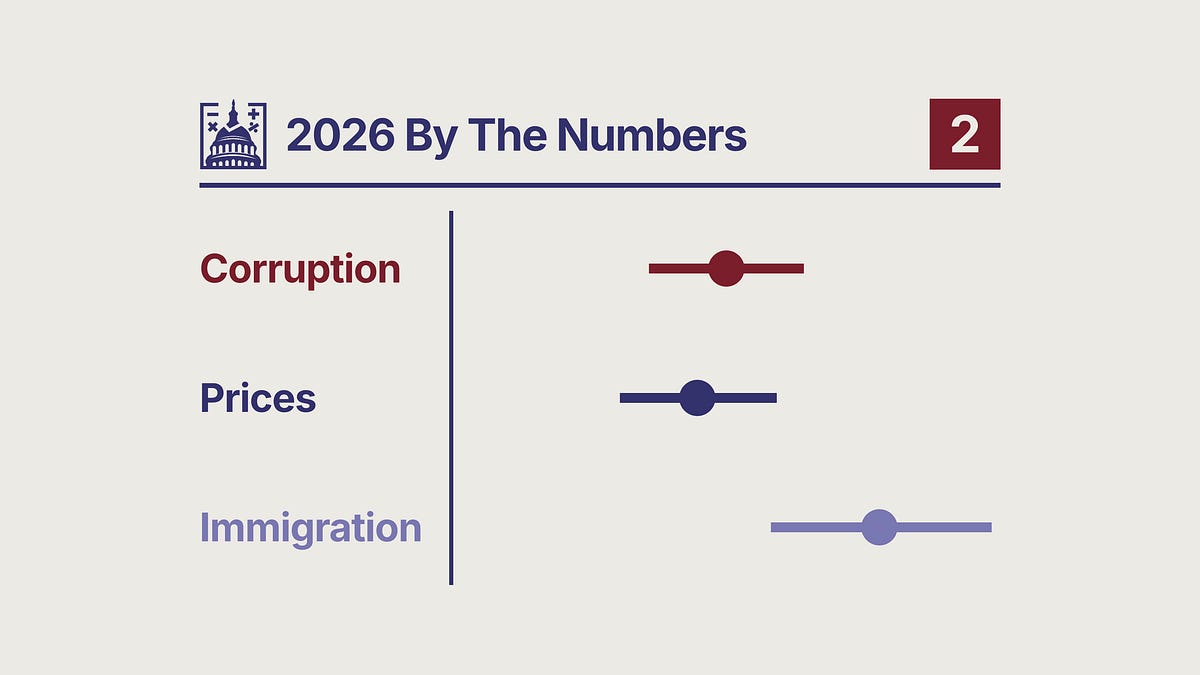
ICE cost Republicans more votes than inflation did in 2026
Hardly anyone left Trump over prices alone. Interviews with 20.000 voters show what else drove the blue wave
SCOOP: ICE to pay $32 million for Roxbury, N.J. warehouse conversion by Michael Wriston, Mia Barragán, Em Chapin
The original record, posted Nov. 5, described the work as the renovation of a building in San Antonio.
The contractor, SK2 LLC, is the Tennessee company that helped DHS buy warehouses for immigrant detention this year. It received a $31.8 million order on Thursday to renovate the Roxbury warehouse into a processing and detention center, according to federal contracting records and a person familiar with the award.
The state has asked DHS for a copy of the contract. If DHS has signed a deal to convert the site, the filing says, that “raises significant concerns” about whether it is following a May court order, and the state and township may ask the judge for relief. “If the Trump Administration is violating that order, we will take action to ensure that order is respected,” a spokesperson for Attorney General Jennifer Davenport said in a statement.
Despite the San Antonio description and the Newark address, the person familiar with the award said the order is for the Roxbury warehouse, which is in Morris County, about 35 miles northwest of Newark. ICE declined to comment, citing the ongoing court case.
The agency’s own warehouse in Roxbury, N.J., remains tied up in court. DHS bought the 470,000-square-foot building in February for $129.3 million. New Jersey and Roxbury Township sued in March, and a May agreement in that case bars the agency from converting the property until it completes an environmental review.
Federal lawyers told the court this summer that DHS planned to sell the warehouse, then reversed course within days. A September filing said the agency still had no timeline for a decision.
The order’s written description places the renovation at an ICE-owned building in San Antonio, where the agency bought a 640,000-square-foot warehouse in February, and does not mention New Jersey. Steve Kelley, SK2’s chief executive, did not respond to a request for comment.
GardaWorld Federal Services, the Virginia-based arm of Montreal’s GardaWorld, already holds a contract to convert the San Antonio warehouse.
A man arrested in a Sept. 4 raid in nearby Dover told NPR’s Jasmine Garsd last month that agents drove him to the Roxbury warehouse. He said he and others were held in handcuffs in its parking lot for several hours before being moved to an official detention center. DHS declined to tell NPR whether it was holding people at the site, citing the pending litigation, and the New Jersey attorney general’s office said it was looking into the reports.
ICE later acknowledged in an email to Rep. Analilia Mejia (D-N.J.) that agents brought 14 people to the warehouse’s parking lot for “initial processing” on Sept. 4 and Sept. 8, but said none were taken inside the building.

SCOOP: ICE to pay $32 million for Roxbury, N.J. warehouse conversion
The firm that brokered the agency’s warehouse purchases will renovate its Roxbury property, which a court agreement bars ICE from converting until an environmental review is done.
NJ warns feds might be forging ahead on Roxbury migrant jail by Dana DiFilippo
https://newjerseymonitor.com/2026/11/17/nj-warns-feds-might-be-forging-ahead-on-roxbury-migrant-jail/Attorney General Jennifer Davenport said state officials have repeatedly sought details on a $31.8 million contract Homeland Security officials signed earlier this month to convert the 470,000-square-foot warehouse it bought in February into a processing center for detained migrants.
But the feds have not forked over the contract or otherwise answered questions, despite the state’s and township’s “urgent need for information,” Davenport told U.S. District Court Judges Jamel K. Semper and James B. Clark III in a joint status report filed Monday.
“If Defendants have already committed resources to converting the facility, then any forthcoming EA (environmental assessment) will be mere window dressing for a decision that has already been made — subjecting Plaintiffs to a wide range of infrastructure, environmental, and public health harms without the required review,” Davenport wrote.
Converting the warehouse into a mass detention center would overwhelm local sewer and water infrastructure, and environmental assessments, “if properly done, would confirm that the warehouse is unsuitable as a site for a detention center,” Davenport added.
The status report is the latest filing in a lawsuit Gov. Mikie Sherrill’s administration and Roxbury’s GOP-leadership filed in March to stop the plan. The state and township succeeded in May in putting a temporary hold on it. The Trump administration has gone back and forth in subsequent court filings about whether the plan is moving forward.


Add a comment: