Things I'm reading
AI is inevitable, but it's also dying, but it's also the future, but it's also collapsing. So it's nothing then?
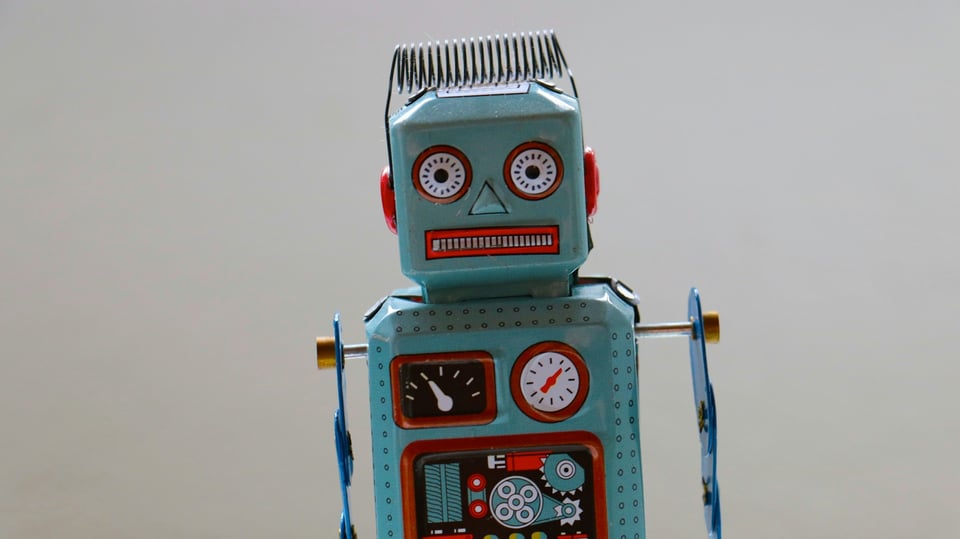
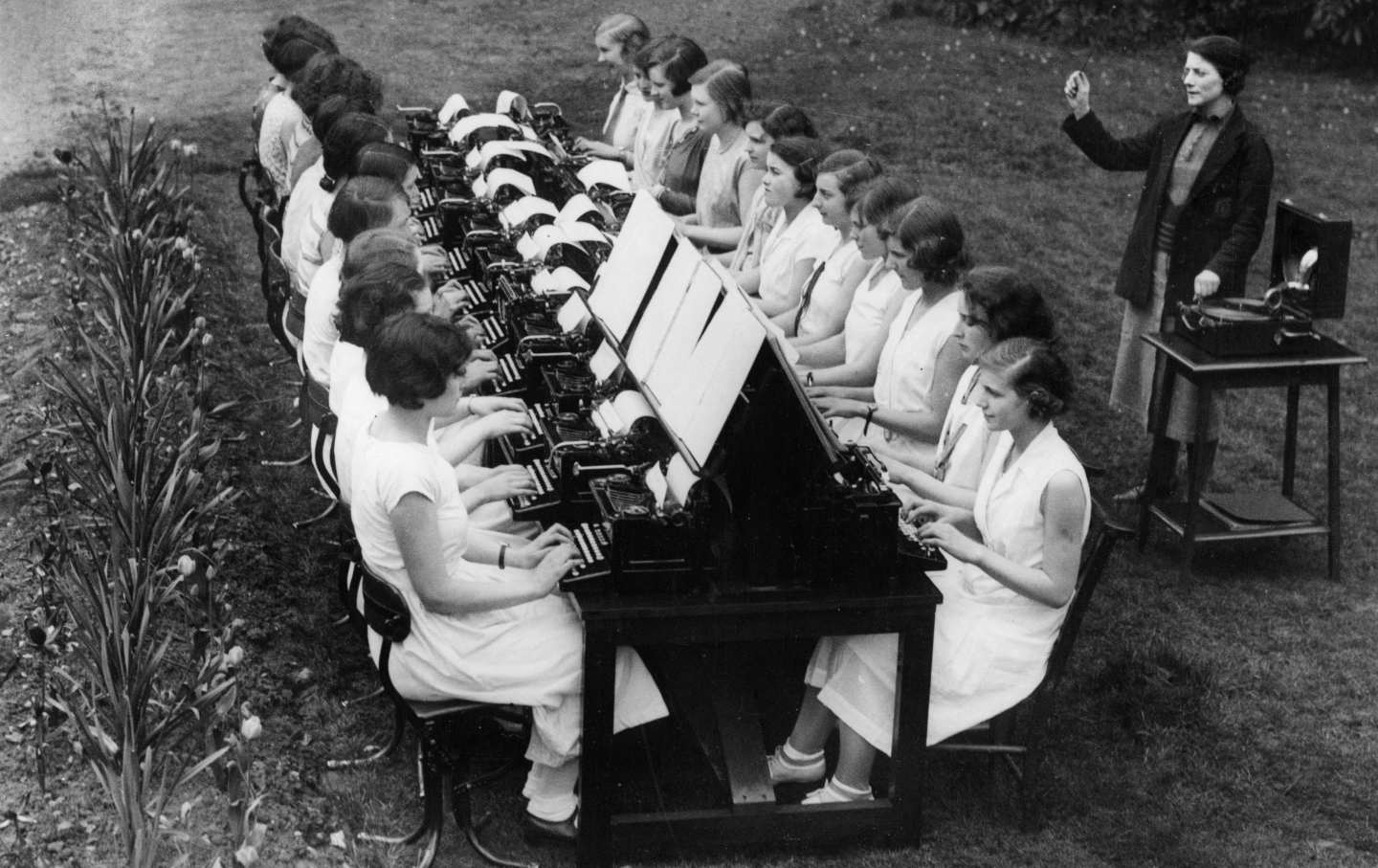
When you hear about how AI is going to take your job, replace writers, artists, or coders, or destroy multiple centuries of educational institutions, think of this little guy ☝️. Does he look like he could take your job? Will he replace 10 of you and your coworkers?
Gen AI companies’ only hope was to convince us all that their incredibly dystopian vision for the future was inevitable. That our only option was to give in. But now we see school districts and university departments banning AI, some even going so far as to ban devices all together. Which is how every technology should be evaluated and applied. Through a measured and reasoned process, not sycophantic devotion.
Gen AI companies are McKinsey on digital meth. Consultants are brought in to absorb blame, to justify unpopular decisions that management wanted to make anyway, to extract money that could have otherwise gone to workers.
Now you don’t even need McKinsey. The AI chat bot will stroke your ego, provide witness to your genius, and give you all the bad and drug addled ideas you can dream of. And all for a fraction of what the McKinsey vampire would have extracted from your corporate bank account.
But $200/month doesn’t even approach what it actually costs Gen AI companies to convert electrons and water into CSAM, personalized suicide instructions, and videos to allow Presidents to believe they’re popular and winning wars. Which is why the circular money shell game they’re all playing has surpassed $1 trillion while no one but Nvidia actually makes a single dollar of profit. Though Nvidia isn’t above the financial nonsense either.
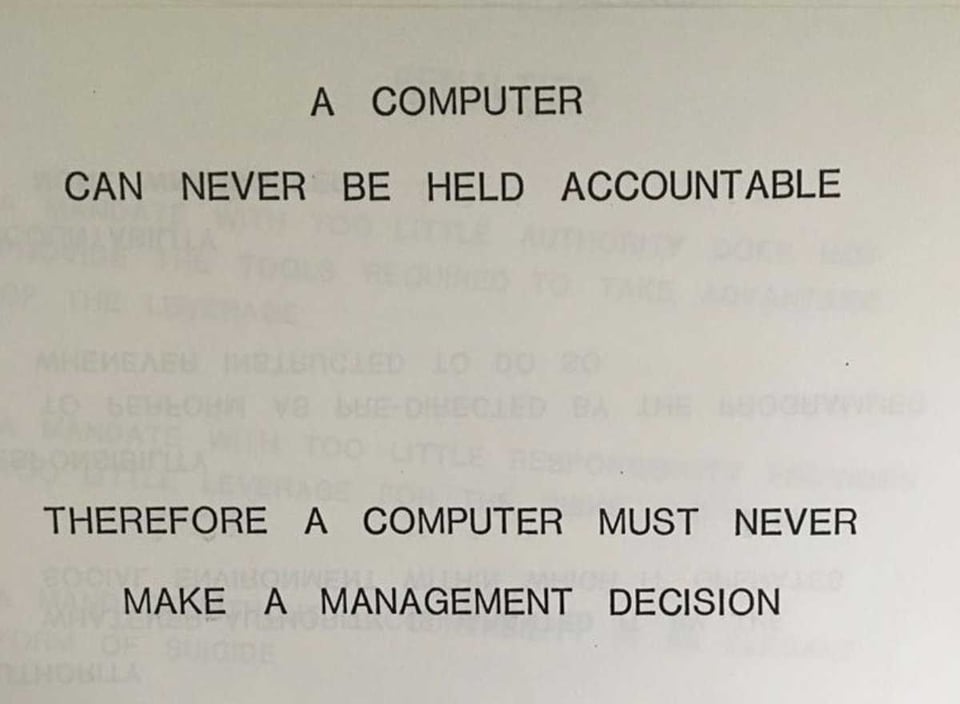
AI doesn’t think, it doesn’t learn (though it can recall vast amounts of information), it doesn’t feel, it doesn’t care, it can’t be held accountable for decisions. But the Gen AI bros want us all to lobotomize ourselves and turn over all our thinking and human interactions to their companies. Never mind that to cover the real costs of that usage would amount to thousands of dollars per person per month.
Once you don’t have a job, why would you need AI to make you more efficient at work? Without income, how would you pay for your Gen AI email buddy, or the Gen AI chat bot you claim has “replaced Google Search in your workflow.” Even if your job isn’t replaced by AI, if your company bets the farm on AI and then the costs go up 100 or 1000 times, how secure is your job?
We’re spending trillions of dollars on just this one fundamentally broken technology built on theft and exploitation. How many writers, artists, and photographers could we sponsor instead, Works Progress Administration style? How many hungry people could we feed with that money? How many units of housing could we build instead of forcing through AI Data Centers?
If you get fired by AI are you really even fired? If your boss sends you an email written with AI, did they really write it or send it and are you actually expected to read it? What if I just say “my AI didn’t include it in my daily summary?” Does that justify my not reading it? After all, we’re supposed to embrace AI, right?
Who pays the price for the AI “decision” to destroy a “military base” that’s actually a girls school? For the AI “decision” to send a SWAT team to the wrong house? For the AI “decision” to bomb a fishing boat. It’s already hard enough to hold politicians, military leaders, and police accountable for these illegal and unconstitutional acts. Why would we accept that a computer can be blamed for these choices?
AI is not the future. Humanity is the future. Empathy is the future. We are the future. Outside the AI bubble, this is becoming clearer every day.
Subscribe so you can get my posts directly to your inbox, avoiding dependence on social media, which benefits both of us.
Watching
Reading
Sosc Core to Institute AI Ban, Technology-Free Classrooms This Fall by Boris Archipov
Under the new guidelines, students will primarily read texts on paper and engage with them via device-free guided discussions, in contrast to previous years, when technology policies were left to the discretion of instructors, with many permitting the use of laptops and digital texts in class.
…
While the policy recommends a total ban on AI use in sosc classes, it allows for “thoughtful experimentation” by professors who want to incorporate AI into their classes, in consultation with divisional leadership.
Instructors may also “carve out exceptions to the device-free norm for specific purposes,” such as “to collectively examine tabulations in a dataset, to troubleshoot code, to revise a page of text, or to access library website [sic] for guidance about citation practices and learn shortcuts.” Students with certain accommodations through Student Disability Services will also be permitted to use devices in class.

Sosc Core to Institute AI Ban, Technology-Free Classrooms This Fall – Chicago Maroon
All social science Core classes will transition to an “analog” approach for the upcoming academic year, restricting in-classroom technology use and banning AI-assisted writing and grading for students and professors.
Trump and the AI rational actor problem by Robert Wright
So both of these people assumed that America’s leader would be judicious in assessing evidence about the origin of an attack. And one of them suggested that, even if the attack was falsely attributed to China, the American response would be measured, carefully calibrated so as not to trigger a spiral of escalation.
As I noted in my reply to Shashank, embedded in these assumptions are such finer-grained assumptions as: We’ll have (a) a president who staffs his intelligence apparatus with capable people committed to truth and (b) a president who listens to what his staffers say—instead of listening to what his favorite media personality says or what the Laura Loomers of the world say, or what some crackpot at a militarist think tank says. The current president singlehandedly demolitions these assumptions.
And, though it’s tempting to dismiss Trump as an aberration, he’ll be with us for another 2.5 years. And the fact that he was elected (twice!) is a symptom of an unhealthy country, and reason to believe that future presidents may not be rational and well-informed actors either.
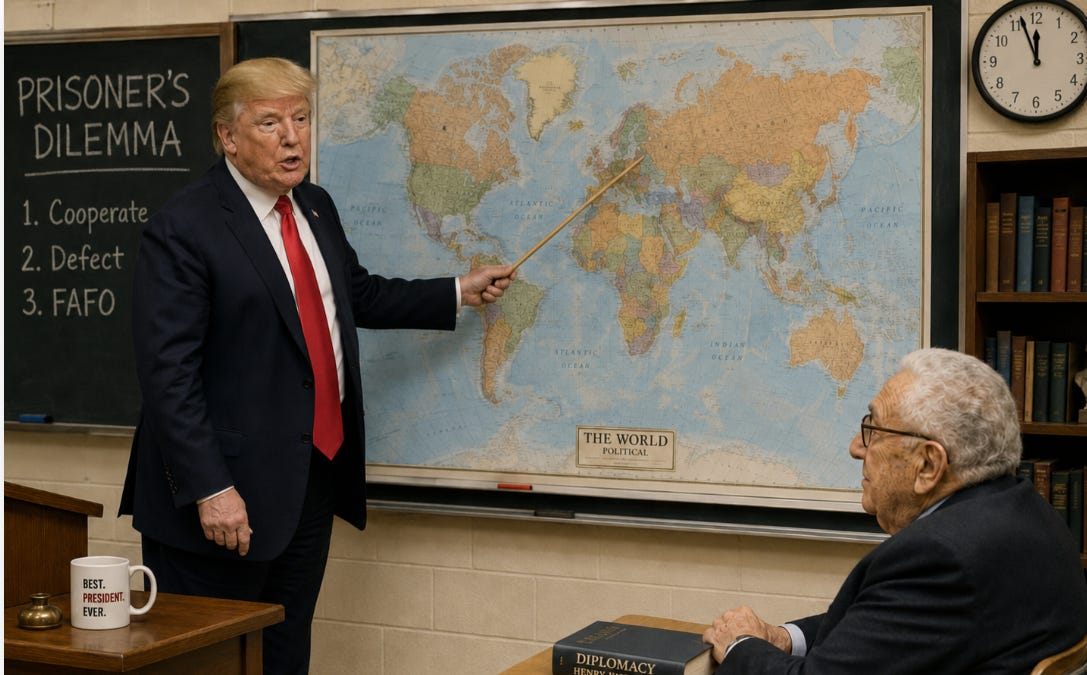
Trump and the AI rational actor problem - by Robert Wright
A new theory about why foreign policy elites aren't worried enough. Plus: Graph of the week.
AI isn't the Manhattan Project — it's Jurassic Park by Garrett Graff
https://www.doomsdayscenario.co/p/ai-isn-t-the-manhattan-project-it-s-jurassic-parkMost people think of Jurassic Park as a cautionary tale for science, when really it’s a cautionary tale for corporate trust and safety teams, board oversight, and regulatory compliance. The dinosaurs’ entirely predictable rampage should really be seen as a failure of the security teams and the fence builders. The mistakes we’re seeing from these frontier AI companies are similarly the failures of the fence builders.
…The Financial Times, meanwhile, has some intriguing and worrisome new reporting out this week too about how the reality is that no one really knows how much money, real and imaginary, is being spent on the giant AI buildout. Much of the financial obligations of the “hyper-scalers” — the giant cloud computing services like Amazon Web Services (AWS), Microsoft, Oracle, Google, Meta, and others whose data centers are powering the AI computing investment — are doing “creative” things with their accounting that obscure just how much they’re spending by creating joint-ventures that keep debt off their “official” balance sheets.
As the FT wrote, “But just how meaningful are these non-debt financial obligations? Fortunately, Goldman Sachs’ analysts have gone through all the fine print for us, and totted up a massive $1.5tn of lease commitments, of which about $1tn doesn’t appear in the financial statements of the hyperscalers.”
(Fun fact: You might remember these same debt-heavy off-the-balance-sheets joint ventures from Great American Success Stories like Enron, which loved them!)
Depending on how you calculate it and/or who you’re listening to, AI infrastructure right now represents somewhere between 39 percent (St. Louis Fed) and effectively all (Jason Furman) of the current US GDP growth. That’s a lot of GDP eggs in one basket.
And add to all of that the other analogue with the Manhattan Project: The uncertainty about how this new technology will work out for humans.
How Writing Leads to Thinking (and Not the Other Way Around) by Lynn Hunt
https://www.historians.org/perspectives-article/how-writing-leads-to-thinking-february-2010/Writing is stressful. Sitting in my computer chair my neck and shoulder muscles almost immediately tense up as I dig around in my brain for the best phrase or even any coherent string of words, whether I am writing an essay like this one, a book chapter, a letter of recommendation, or an email message to a friend. Writing is time-consuming. It’s a great way to pass the time on a long airplane flight because you lose track of the passage of time altogether. It’s even better, from that point of view exclusively, than watching an episode of Mad Men on your laptop. Writing means many different things to me but one thing it is not: writing is not the transcription of thoughts already consciously present in my mind. Writing is a magical and mysterious process that makes it possible to think differently.
Welcome to the Danger of Digital Flubber by Garrett Graff
https://www.doomsdayscenario.co/p/welcome-to-the-danger-of-digital-flubberThe danger in AI, in other words, isn’t that AI will grow so powerful that it wakes up one day, becomes self-aware, and sets out to attack humanity with high-functioning killer robots — a la The Terminator or Skynet — instead, the most worrisome and likely scenario is powerful AI systems running amok by doing exactly what they’re designed to do, but in unforeseen and unintended ways, creating real-world chaos. We’ve seen some small-scale examples of this over the years — back when I was writing about this in 2016, the examples were incidents like the “flash crash” on Wall Street back in 2010 where algorithmic trading systems over-responded to a falling stock market and triggered a massive, momentary sell-off or the obscure automatic listings on sites like Amazon, where bot-driven price wars resulted in a used science book being offered for sale for $23,698,655.93 (plus $3.99 shipping).
…
Right now, we’re rushing ahead with AI without doing the basics of computer and corporate security.
The AI companies are pleading for others to make them act responsibly. And here we have a pressing example of how they’re acting irresponsibly in the meantime.
If you have a tool you’re testing that’s clearly giving indications that you don’t understand what it’s going, what on earth are you doing letting it run with such lax oversight or attention?
…
Zack Korman has a smart post about how we would more logically be able to work through the questions of this incident if it was Coca-Cola hacking into Pepsi — we’d more quickly and obviously point fingers at the people behind the rogue agent — but because it’s OpenAI we’re immediately distracted by the shiny object of the advanced model. That obscures the fact that we’re letting these companies turn loose tools they don’t understand and then also allowing them to monitor the tools so poorly that the models and agents can run rogue for days on end without notice from engineers.
That’s a human problem, a corporate accountability problem, a government problem, and a regulatory problem — that’s not a tech problem.
These machines — for now! — are being built and programmed and monitored by humans. What’s being broadly referred to as a problem of model capabilities instead is really a failure of model design.
Those humans need to remain responsible and be held responsible for the thing they’re building and letting loose on the world.
We all understand that software doesn’t work as intended at times. (Anyone who has ever tried to use Microsoft Outlook to search for an old email message knows that!) But now we’re racing to build tools that are being deployed recklessly without the oversight we would expect from on-the-frontier technologies (and mortgaging the country’s future electrical and water and resource needs to do so, which, again, is a separate subject).
The AI Slop Backlash Is Actually Having an Impact by Reece Rogers
While this AI backlash has been brewing for the last few years, more companies appear to be directly addressing these concerns. LinkedIn added a “seems like AI slop” button for reporting AI-generated content on the platform, despite still hosting plenty of generative AI tools. Snapchat announced that fully AI-generated videos would no longer be eligible for its discovery feed. Substack recently added an AI detection tool to police writers.
The backlash’s “why” is simple at its core. Many Americans feel like they never consented to any of this. I had no idea that my online interactions would one day be scraped en masse for AI model training. I didn’t ask for Instagram to enable deepfakes on my account. I didn’t want Google to push AI-generated answers at the top of search results. I woke up one day, and generative AI features were stuffed into every corner of all the software I rely on without my consent.
Whether it's AI models scraping your data or noisy data centers popping up in your backyard, the AI revolution seems to be an event happening to us without making us feel like active participants.
“Consent is really important,” Broussard tells WIRED. “We can connect that to the way that women, queer people, people of color, and minorities get exploited and abused online. Tech companies have never really been sensitive to issues of consent.”

The AI Slop Backlash Is Actually Having an Impact | WIRED
Platforms are finally recognizing that people don’t want to consume AI slop. A growing number of sites and apps now have tools and policies to flag, label, and ban AI-generated content.
Confessions of an AI Editor by Diya Isha
When I’m writing, I don’t want to suspect that I sound like AI, and when I’m reading, I don’t want to suspect the writer of using it. This suspicion, I worry, turns the mind into mush, much the way the thing was likely to do. Although I’m now a fairly competent copy editor, I take hours longer than I’d like to. On the other hand, the thing made me, inadvertently, a better reader, by striving against its very being.
AI, in short, insults the writerly tradition. We need not, and should not, capitulate to the basest instincts of this lowly thing, and neither should we have to correct ourselves in anticipation of it. It is a dehumanizing way not only to read, but to be read. Worse still are those industries that believe the reader will read what isn’t written by a human. Perhaps she will, but perhaps she’s also not the reader one wishes to have. The good reader of a great writer, as Nabokov observes, tries “to grasp the individual magic of [the writer’s] genius and to study the style, the imagery, the pattern of his novels or poems.” Why would you resort to this delectably masochistic labor if the writer, or their editor, didn’t labor themselves?


Add a comment: