Things I'm reading
We spend money on journalism and media. Whose voices are we hearing?
There's been a notable change from early in the genocide when copious first hand video evidence from airstrikes in Gaza was immediately attacked with attempts to sow doubt about their authenticity. “Pallywood,” was the unified response to many early videos of suffering coming out of Gaza. An entire Palestinian run video propaganda industry was invented out of whole cloth.
Yes, Israel was bombing apartment buildings and hospitals, but any "victims" must be crisis actors. The most moral Army in the world doesn’t hurt “innocent” people, that’s not moral, so if they did, they couldn’t be moral. Or if you believed the Pallywood propaganda, THEY couldn’t be innocent. But as Daniel Bessner likes to stress, there is no good empire without bad empire, no good wars, without bad wars. If we want to be precise, Gaza was never a war, but the point holds.
Between 1945 and 2026, the United States did an enormous amount of damage abroad and proved itself unable to support only “good” wars. For every Japan there’s an Indonesia; for every South Korea there’s a South Vietnam; for every Kosovo there’s a Libya; for every Ukraine there’s a Gaza.
Power without Ideology - Daniel Bessner
Fast forward through the long years two and three of further genocide, and those false accusations have entirely ceased (at least in the social media I consume, not including the Nazi bar). The Hasbara chorus has completely abandoned the false video featuring actors storyline. And it's important to ask, why?
During those two years AI video has completely scrambled our sense of reality. Yet there has been no meaningful claims that videos of ongoing strikes, even during the "ceasefire," are AI. This would have been a natural transition for the Pallywood propaganda crew. You wouldn't notice the six fingers on an AI child's hand that's been blown off. They'd naturally be able to call every last photo and video “AI” while avoiding the fact that the usual tells were missing.
But the reality is, the genocide is just too large to paper over with basic lies anymore. A single Palestinian face, captured on videos carrying several limp children's dead bodies to ambulances or medical tents isn't suspicious when strike after strike after strike have targeted neighborhoods, block by block, building by building, home by home. Of course the same people are reacting when an apartment building is leveled today, two lots down from the building that was blown apart two days ago. That person lives on that block, and the IDF hasn’t succeeded in fully “cleansing” that block yet.
And those familiar faces became rarer and rarer as the double-tap and triple-tap strikes intentionally targeted more and more of the helpers, the medics, the journalists, the regular people running towards the blast, crawling through the rubble, and then climbing the rubble to get enough cell signal to get the video out. Hoping that when we saw that footage, we’d do something, anything, to end the genocide.
The IDF heard Mr. Rodgers, looked for the helpers, but they perverted his legacy, vaporizing the helpers instead of celebrating them. That must tell us something. Instead of buying into the propaganda, we must listen to the helpers, before they’re all gone.
The pieces I’m sharing here aren’t all Palestinian voices. But importantly they’re all centering, amplifying, and capturing Palestinian voices telling Palestinian stories. They’re using their whiteness, their Americanness, and their Jewishness to help break through the noise and propaganda.
Will we listen?
Subscribe so you can get my posts directly to your inbox, avoiding dependence on social media, which benefits both of us.
Donating
Listening
Watching
Resist by Rev Sekou
Resist when they tell you who is and ain’t your neighbor
Tell them to hush their mouth, cause you’ve done had enough
Resist when they tell you that the love of money is your only goal
Because you don’t want to gain the world and lose your soulSo hold on just a little while longer
Cause that which don't kill you, will make you stronger
Reading
The Palestinians Who Rescued Heidi Levine by Jasper Diamond Nathaniel
I didn’t even know there had been a Palestinian shot by the IDF in this confrontation until reading this piece (and lots of folks would say I’m overly focused on Palestine). So yet again, the coverage and politicians have focused on a white, Jewish, American reporter being beaten and left out the fact that the IDF response was to invade a village and shoot an unarmed Palestinian and then lie about the justification. This is decades of anti-Black policing, exported from the US, having cross-pollinated across the world.
Read this whole piece, and send it to everyone who tells you the IDF is moral, this is somehow different that Jim Crow oppression of Black people in the US. Send it to anyone that says the settlers are just a fringe group of misguided youth. Send it to those that that say this isn’t ethnic cleansing and isn’t on a path to expanding the genocide. Live streamed, photographed, and videoed, yet somehow underreported at best, and not reported at worse.
Before heading into the fields, the villagers had coordinated with the IDF to obtain permission to harvest their own olives. In other words, the military had agreed that, for a few hours, it would stop the settlers living on Palestinian land from attacking its rightful owners. But the military was nowhere to be seen, and about an hour into the harvest, dozens of masked settlers began streaming down the hill.
The farmers frantically packed their equipment, knotted their tarps into sacks of olives, and retreated toward the village. But not everyone fled. As the masked settlers approached, launching massive stones with slings capable of sending them hundreds of feet—projectiles that routinely maim those they strike—dozens of young Palestinians emerged: the shabab. They had come out to protect the farmers during the perilous harvest. They pulled masks over their faces, picked up stones, and prepared to defend the community against the invaders.1
Palestinians convicted of throwing stones in the West Bank face three to twenty years in one of Ben-Gvir’s torture camps; after settler attacks, it is routine for soldiers to raid villages and arrest the locals they accuse, often baselessly, of throwing stones. Or they face instant death, since soldiers and settlers are known to shoot Palestinian stone-throwers on the spot.
But this was not simply about protecting the harvest. In Abu Falah, as in many Palestinian communities, the olive fields are a buffer between the violent outpost and the village’s residential core. If the settlers broke through, there was little doubt they would carry out a pogrom. They would burn homes, brutalize residents, and attempt to push their territorial control into the village itself. Since October 7, settlers have emptied over sixty Palestinian communities this way. For the shabab who stepped up to confront the settlers, the stakes were existential.
…
Around the same time, at least one military jeep pulled up beside the settlers and began firing tear gas at us. Through the smoke and gas, I saw a white pickup truck tear down the hill from the outpost, with two or three masked settlers in the back holding M16s—a sight reminiscent of the darkest days of ISIS. Then they opened fire. Everyone on the Palestinian side, myself included, turned and ran back toward the village through smoke, tear gas, and gunfire.
When we cleared the cloud, I turned around and saw several settlers within the larger mob surrounding someone they had caught, beating the person mercilessly with fists, feet, and clubs. I later learned that it was Heidi Levine, a legendary 63-year-old Jewish American photojournalist working for The Washington Post. At one point, a settler grabbed her by her blue vest, clearly marked PRESS, and hauled her to her knees—I thought he might be helping her. But he was holding her up so another settler could kick her in the stomach and knock her back down. As they beat her, others descended and stripped her of everything she had: camera equipment, phone, wallet, passport.
I had no doubt the journalist, whose identity was still unknown to me, could be killed. Several of us looked for a way to reach her: the journalists Adele Shoko and Andrey X, Palestinians who cannot be named, and me. But the air was thick with smoke and tear gas, and settlers had fanned out across the fields, still slinging enormous stones. There was no way around them, only through. So we began, cautiously, pushing forward.
In a video of the incident, you can hear a Palestinian shouting, “Shabab, go forward, they have a journalist!”
Within moments, stones began flying from behind us—the shabab were giving us cover. The settlers began retreating, allowing me to run ahead and reach her. I was, to put it mildly, surprised to find someone who reminded me more of my own mother than someone I’d expect to encounter in the olive fields on a day like this—surely the settlers who beat her nearly to death had a similar realization.
I helped Heidi to her feet and, with Adele and Andrey, began pulling her back toward the larger group of Palestinians near the village. She was dazed and in agony, struggling to move. Then the settlers charged again. For the first time, I thought we might be overrun. As I pleaded with Heidi to run, she repeated, “Let me die.” Then I realized the shabab had formed a perimeter around us, throwing stones to hold the settlers back.
…
Then the soldiers drove past the masked settlers they had been protecting and into the village. Minutes later, we heard gunshots. We ran toward the sound and found a man, Abed Aljaber Obied, writhing on the ground. Soldiers surrounded him, pointing their guns at the paramedics trying to reach him and shoving reporters away from the scene. They threw Andrey to the ground. The New York Times, whose reporters witnessed the shooting, later reported that Obeid, a 53-year-old member of the local council, was running away from soldiers when they shot him in the leg. The IDF claimed he had charged at them with a sharp object, threatening their lives. But a Times photographer captured Obeid fleeing, with nothing but a small red plastic gardening tool tucked in his back pocket. After shooting him, the soldiers demanded his ID and threatened to prevent medics from evacuating him unless he produced it.
…
We went over what happened. She was running, she told me, when suddenly she was shoved to the ground and felt blows raining down. She pleaded with her attackers in Hebrew, telling them she had children their age, begging for mercy. The beating lasted several minutes. She thought they might kill her.
Without her helmet and flak jacket, we agreed, she could easily have been killed. Same if she’d been Palestinian. And above all, had the shabab not stepped up to protect her, she might well be dead. It is no exaggeration to say that young Palestinians armed only with stones risked their lives to save Heidi Levine’s.
Many people have rightly pointed out that assaults like this happen every day in the West Bank, and that this one is getting attention only because the victim is American. The Palestinian man shot that day has received a fraction of the coverage. So have the dozens of olive harvesters wounded in at least 34 settler attacks across six districts that same day. And so has Haytham Taysir, a Palestinian American beaten nearly to death in Burqa the day before. (In such cases, the Palestinian seems to negate the American.)
But there is another double standard at play. In any other context, the people who fought to rescue someone from a vicious mob attack would be hailed for their bravery. Here, the mere sight of masked Palestinians throwing stones has been enough for countless people, including the Prime Minister of Israel, to dismiss the clear video evidence of what happened. It has been enough to cast the rescuers as the instigators of the attack—and as terrorists.
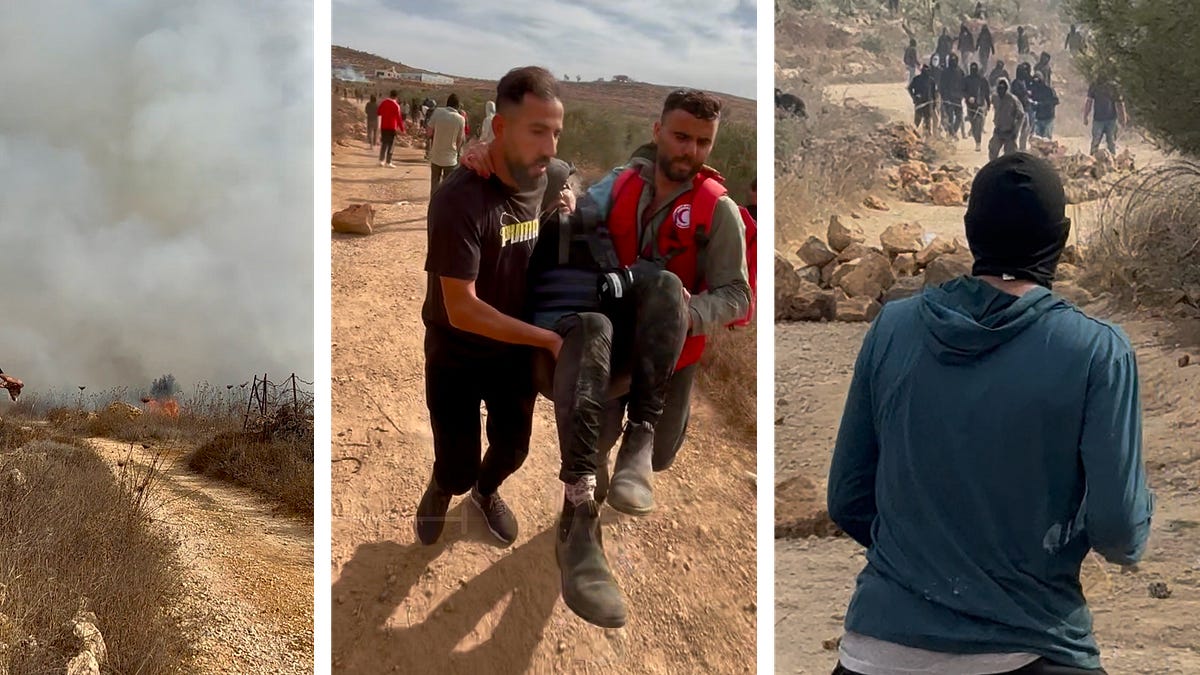
The Palestinians Who Rescued Heidi Levine
My account of the October 16, 2026 assault on Abu Falah.
On Parenthood and Genocide by Heba Gowayed from January 15, 2024
https://inthesetimes.com/article/gaza-genocide-children-israel-palestine-motherAs the sun streams through the windows of our New York apartment, I watch our now five-month-old son grab his newly found feet. He sways as he chats with the baby looking back at him in the mirror attached to the play gym. He breaks into a wide-mouthed smile when he turns and catches my gaze. My chest constricts with the enormity of my gratitude for his existence and joy.
And, as I have often done in the last 100 days, I think of Gaza.
I think of the mother who, like me, struggled to have a child only to then lose him to the flippant brutality of bombs dropped from the sky. Of the father desperately clutching his soot-covered daughter, her fat arms and feet dangling limp against his chest. Of another father who tried to wrap a cookie into his son’s lifeless hand. He had been so excited to find his son a treat at the market only to come home to find him dead. Of the babies lined up in the NICU of a Gaza hospital under attack, who would soon likely not be wrapped in the muslin of a swaddle as my baby was, but in a white kafan (a burial shroud).
For the past 100 days we have witnessed a massacre of children, of childhoods. Of the roughly 24,000 Palestinians who have been killed, almost 10,000 are children. Each had a name. A favorite color. A favorite toy. Each cackled at a parent’s funny face.
It’s Not Complicated by Sara Yasin from March 5, 2026
https://www.thekeymagazine.com/p/western-journalism-palestine-objectivity-legacy-media-genocide-bias-gazaWhen you are in Palestine, you see things exactly as they are. Every way in which Israel makes daily life for Palestinians a nightmare becomes impossible to ignore. The repression is so direct that the disconnect with coverage outside — where Israel’s actions are complicated, obfuscated or simply not written about at all — can be overwhelming.
Last fall, I visited my family in Beit Imrin, a small village in the hills outside the city of Nablus. As I was having breakfast with my uncle, aunt and cousins, we watched a lone settler walking around a distant hill in the village. What is often called a settler “outpost” was taking shape: a few tents, vehicles and stolen sheep to begin with. It won’t take long — maybe a few months, maybe a year — before it’s officially registered as the latest colony to swallow up Palestinian land, further fragmenting what remains of the West Bank.
As we sat there, watching a settler prepare to dig into one of the places where my father, born in 1947, spent his childhood, I realized I had taken those hills for granted. I should know by now that nothing is safe. Those hills — flecked with rows of olive trees, jagged rocks and clusters of ancient stone houses — were characters in my parents’ childhood stories, as alive as the members of their family. My mother and father played in them every day, trekked over them to get to school in nearby villages — and in my father’s case, they are where he sat as he grew older, watching his country disappear.
It can be hard to fathom, let alone capture, what is happening in Palestine at any given moment. Across the West Bank, every day constitutes a rolling story of arrests, home demolitions, court orders, settler attacks, land grabs, one human rights violation after another. Israeli settlers close schools, assault farmers, burn olive trees that have supported families for centuries, carry out arson attacks on warehouses and pour concrete down wells that provide water to entire villages. A journalist from Nablus once showed me one of his group chats to make his point: Updates inundated the conversation, making it impossible to keep up. The only way to focus on any single act of repression was to put his phone on airplane mode.
…
One of the clearest examples arrived early on in the genocide: After Israel’s brutal attack on al-Ahli hospital in October, killing over 471 Palestinians, the phrase “Hamas-run Health Ministry” became commonplace as a part of a successful disinformation campaign to distract from the horror of the massacre by questioning the death toll’s credibility. The next month, the Associated Press, whose Stylebook sets industry standards for how the vast majority of English-language newsrooms navigate sensitive-language issues, issued guidance using that phrase, and many newsrooms followed suit.
Among the journalists I’ve spoken to, there were some who told me they were stonewalled for attempting to question that style decision. Yet after more than two years of sowing doubt over the number of the dead, the Israeli military recently admitted the Gaza Health Ministry’s numbers — the so-called Hamas-run Health Ministry — has always been accurate. And despite the Israeli military’s long history of repeatedly lying to the public, journalists who tried to scrutinize other claims by the army were also rebuffed by their editors.
That institutional resistance to regular journalistic norms around coverage of Israel extended, of course, to the word “genocide.” It’s not a word to be used lightly, but UN commissioners, experts on genocide, international human rights groups have all come to the conclusion that genocide is what is happening in Gaza. But in the world of legacy U.S. media, to describe it as such would be deemed a crime much more serious: It would “show bias.”
That same level of scrutiny is not applied to reporting the Israeli perspective. Take, for example, the U.S. journalists who embedded with the Israeli military to report from Gaza: What was the news value in those dispatches — which could only be made on the condition that the Israeli military conducts a review of all “material and footage” before publication? News organizations have used the lack of access to Gaza to justify embedding with a foreign military, even though local media workers and citizen journalists were already risking their lives to document all of the devastation. I have yet to see any of this reporting do much more than push the Israeli military line, even with a critical eye.
It's Time To Bury Palestine by Sana Saeed
Perhaps the most chilling detail of the families’ extermination was that all 112 had been killed in a single Israeli airstrike in November 2023. Their bodies were only recovered from beneath the rubble a few days ago, after a two-week effort by a recovery team. In many cases, all that remained were fragments of their bodies, identified through a painstaking and, at times, unsophisticated forensic process. The Hassaniya and Abu Sharia families are believed to account for roughly one-third of all those killed that day during Israel’s bombardment of the Al-Sabra neighborhood in Gaza City — a bombardment that flattened the neighborhood and has left entire families buried beneath it for nearly three years. 308 people were killed that day, in November 2023, in this one single neighborhood.
There is still footage, on the daily, being produced of the horrific war crimes Palestinians continue to face in Gaza at the hands of the Israels. Yes, those images occupy our feeds less and less — by design through the targeting and killing of over 300 journalists and media workers - but they are there, even if the frequency of our confrontation with the extermination project has changed.
…
We bury Palestine every time we normalize the news media institutions - like the New York Times — that laid the foundation for the extermination and continue to lie about. We bury Palestine when we give standing ovations to those who directly participate in the project of dispossession just because they have semblance of guilt. We bury Palestine every time we think controlled dissent is a victory, that the greatest resistance is joy.
And perhaps most of all, we bury Palestine when Palestinians are permitted to speak only of their suffering, but never given the space to speak, openly and unapologetically, about their liberation, about their oppressors - in clear, no uncertain terms, however ‘uncomfortable’ it may be to certain sensibilities.
I refuse to bury Palestine.
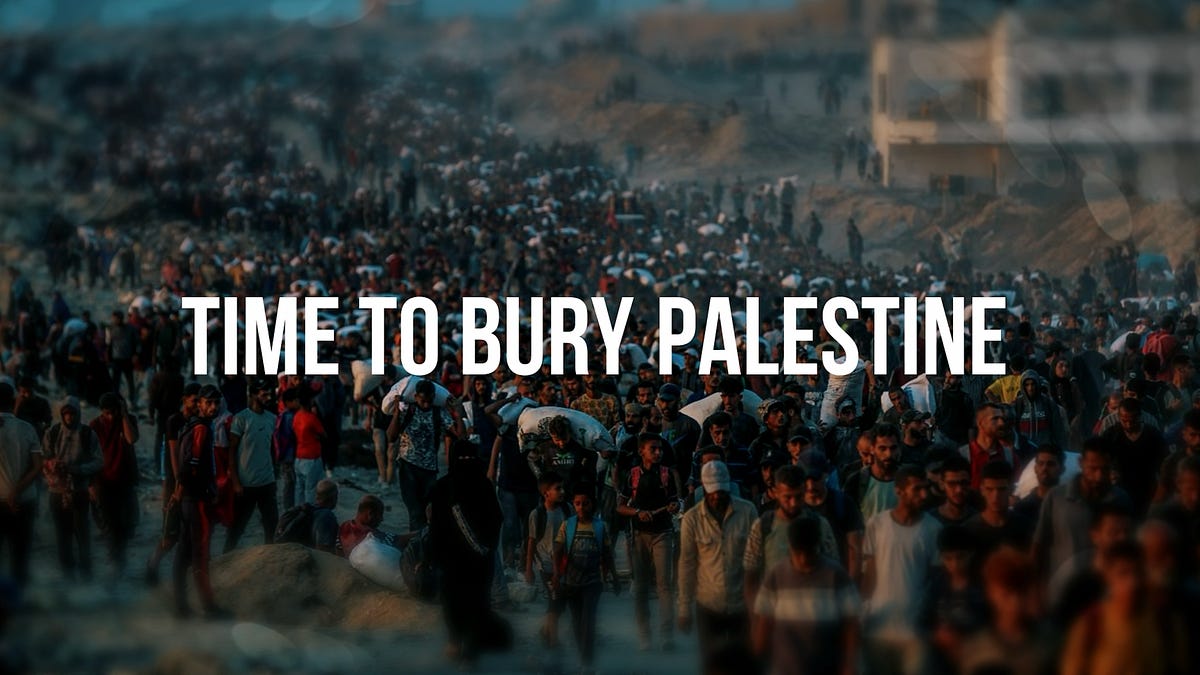
It's Time To Bury Palestine - by Sana Saeed - Views My Own
The pursuit of power requires the abandonment of Palestine - what will stop that?
My Modest Ask from Mainstream Jewish Institutions by Sam Avraham
On August 3rd, my partner was fired from her rabbinical position at Emory Hillel because of her relationship with “someone who speaks disparagingly of Israel.” This is, first and foremost about her. She is the one who faced financial harm and a massive black mark at the beginning of her rabbinical career. She is the one who was the victim of McCarthyism. But I was directly implicated in this, and it is hard not to take it personally.
I am a proud Jew, and if I listed my Jewish “credentials,” I would check all Hillel’s boxes. I grew up Orthodox, and I possess a rigorous knowledge of Jewish text; I engage in Jewish culture and celebrate the holidays; I am a fluent Hebrew speaker, and an Israeli citizen. But I missed the only box that matters: I am not a Zionist. I have in word and in action advocated for Palestinian rights, so not only does Hillel not accept me, but everything I touch is cursed. Being in a relationship with me is a fire-able offense. I am in cherem. This experience is not limited to Hillel. I am guarded in every mainstream Jewish space I’m in. After October 7th, I was kicked out of my jiu jujitsu gym in Jerusalem for opposing Israel’s genocide. I tiptoe around issues at shabbos meals and gloss over facts about myself at shul. I am tired of being looked at like a circus act just because I value all human life.
…
Despite knowing that I am the one being excluded, I have always felt, or been made to feel, that I am the one closing a door. Maybe it’s because these spaces usually stop short of explicitly telling me I am not welcome. They simply put Israeli flags everywhere, celebrate Israeli independence day, and glorify Israeli soldiers and make me feel like the weirdo when I don’t join in. When I finally decide that it is too exhausting to participate in these spaces, I am painted as the one who closed the door.
People often ask me if I would work at a mainstream Jewish institution. Fewer people bother to ask if those institutions would hire me. Hillel, and similar organizations, explicitly describe themselves as pluralistic. But, despite what they say, that pluralism clearly ends at Zionism, as Hillels of Georgia has now made abundantly clear. When their pluralism doesn’t reach you, you are the one made out to be an uncompromising extremist. They force us out of their spaces, and then claim that we’re the ones who won’t be in community with people with different politics. That is what this fight is about. I am not demanding that Hillel turn on a dime and believe everything I believe, as much as I would love that. All I am asking is to be let in the room. That people “guilty by association” with me be let in the room.



Add a comment: